


Customer feedback analysis means reading what your customers already told you in reviews, calls, forms, and questions, and then acting on it. Analyzing the voice of the customer can (and should) inform how a whole business runs. This post zooms in on one part of it: your messaging in your marketing.
I got into this because I was sick of writing content that could have been about anybody. Plenty of SEO content ranks fine and converts nobody. The thing is that the people who approve a page aren’t the people it’s for. Their customers are. In an agency, our clients’ clients decide whether to pick up the phone or not. So I started digging for anything that helped me zero in on what paying customers care about most.
Reviews were the obvious place to start. Then call notes. Then form fills, and the questions people ask before they book. The answers had been sitting there the whole time, usually in words, feedback, and sentiment businesses never mine for the treasure they are.
If your page could belong to any plumber in town, don’t be shocked when people call a different one. Here’s the short version:
- Pull every review, call note, and form note you can get.
- Have AI group it all into themes and count them. (Then check its math.)
- Read the complaints, yours and your competitors’, for what makes people hesitate.
- Say clearly who you are and where, then lead with what customers praise most, everywhere someone decides whether to call.
- Measure whether more people reach out.
Customers can tell when a page could be about anyone
People can spot generic, blasé, lackluster content within a few seconds of skimming — and that’s whether a person wrote it or an AI tool did. In a local business context, give users and bots naught more than a service and a city, and watch both bounce: users will just peace out, Googlebot will discover or crawl your page but may not index it, and it certainly won’t reward low-effort pages with decent rankings.
Content may be king, but specificity reigns supreme. Someone calling a plumber at 9 p.m. wants to feel like the company on the other end gets it: the water on the floor, the worry about the bill, the last guy who never called back, the tech who explains things carefully and clearly. Reviews and other customer feedback are where clients tell you what matters to them.
Your reviews are a brand guide your customers wrote for you, for free. They show what paying customers value, what almost stopped them from calling, and how they said it in their own words.
Feedback lets you anticipate the questions, objections, worries, and hopes people bring to your page, then answer them before anyone has to ask. Every bit of friction you remove is a win for conversion. If someone leaves your page still wondering whether you charge just to come out, they may never call — especially if a competitor’s page says plainly that it doesn’t.
Before you blast generic, informational content on your money pages, it helps, too, to understand that being specific matters for rankings. In the federal antitrust case against Google, Judge Amit Mehta’s 2024 opinion describes a Google system called Navboost that matches searches to pages “through memorizing user click data.” His 2025 remedies opinion adds that “Google trains Navboost on 13 months of user data.”
Put simply, Google learns from which results people pick and how they engage with the pages they choose. A page that reads like every other page in town gives searchers no reason to engage with yours. And the painful truth is that users may not even have the chance to pick you if you are just spraying generic, painfully dull pages on your website, because Google may not even index them.
Don’t mishear me: This isn’t the time to get cutesy. If you pave roads or plumb pipes or plaster walls, then say so clearly, explicitly, and immediately. Undoubtedly, though, you can check all the visibility best-practice boxes while still resonating with your customers through distinctive, engaging, conversion-driven content.
What customers praise is rarely what businesses lead with
What customers praise and what a business leads with overlap less than most owners think. We see it almost every time we analyze a client’s reviews in full.
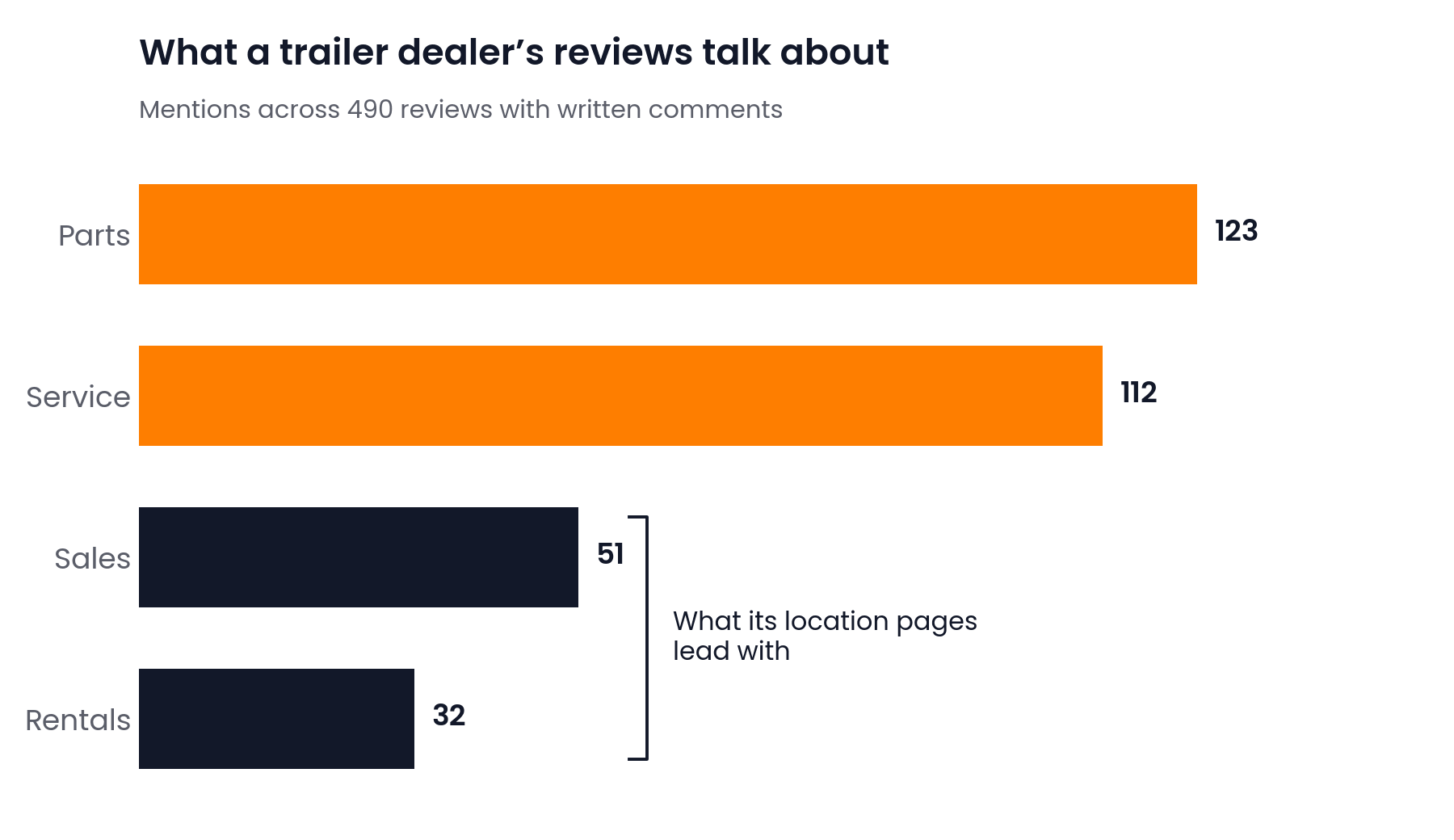
Take a trailer dealer we work with. Its location pages lead with sales and rentals. Its customers talk about something else. Across 490 reviews with written comments, parts came up 123 times and service 112. Sales got 51 mentions. Rentals got 32. Revenue priorities can override customer sentiment. But the results are at least food for content thought.
A plumbing company’s 293 most recent reviews focused more on the person who showed up than anything else. 125 praised the techs’ professionalism. 89 valued that the techs walked them through problems in detail.
A dental practice billed itself as premium and technology-forward. Its patients wrote about how the visit felt instead: “no pain,” “comforting,” and a dentist who will “explain everything.” For someone who has put off the dentist for years, that’s what lands the sale.
A facial plastic surgeon’s site leans on the names of its surgical techniques. Across 269 Google reviews, patients used those names four times. They wrote about staff they knew by name (112 reviews), the surgeon’s eye for detail (98), and results that still looked like them (77). Recovery came up as “no packing” and “no bruising,” not as a procedure name. Now, of course, our pages have to point clearly to surgical facts. But customers want more than “just the facts, ma’am.”
Where to find customer feedback
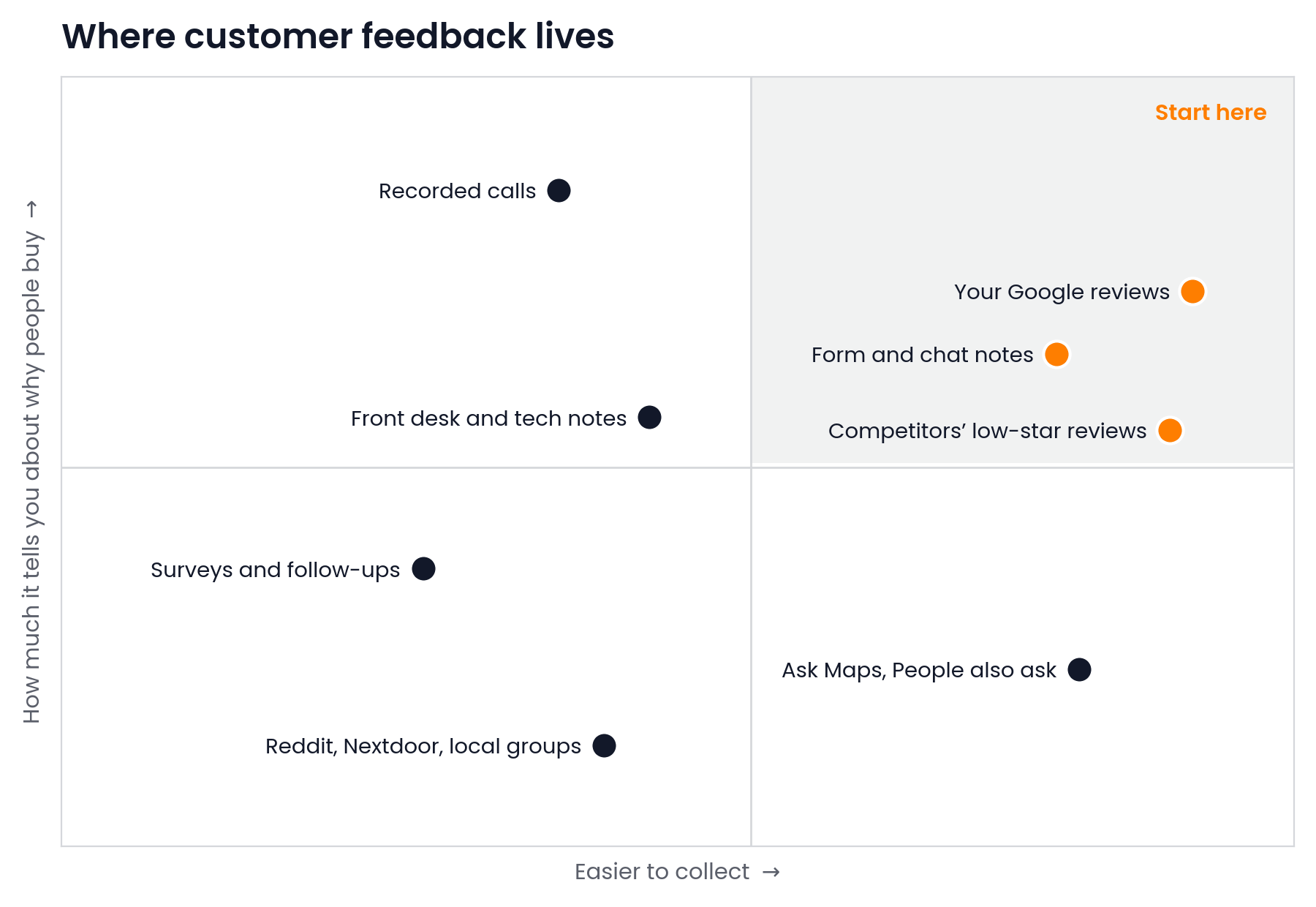
Customer feedback lives wherever your customers are heard. We list eight common places here. If you’ve limited yourself so far to your star rating, start here: your Google reviews, your competitors’ low-star reviews, and the notes people type into your forms. None of them cost a thing, and you already have easy access to them.
-
Your Google reviews
Your Google reviews are the easiest place to start. Do the same with Yelp, Facebook, Angi, or anywhere else your customers leave reviews. For a few dozen reviews, copy and paste works fine. For more, Google Takeout can export the reviews your Business Profile has received, though big profiles sometimes come back partial, so check the count against your listing. A reputation management tool can usually export them too. Agencies pulling reviews for clients will need a reputation management tool or a review scraper. We walk through the Takeout export in our post on local keyword research from reviews.
-
Competitors’ reviews
Your competitors’ five-star reviews show what your market rewards. Their low-star reviews show what goes wrong, so start there. Open a competitor’s listing in Google Maps and sort its reviews by lowest rating. Say a rival’s low-star reviews keep saying “never called back.” Promise a callback window. Then keep it. That sounds like standard good practice, and so it ought to be. But would you think to highlight something so simple, yet clearly impactful, on your service pages?
-
Recorded calls
If you use call tracking, your recordings are the rawest feedback you have: people describing the problem in their own words, often while they’re still exploring their options, before anyone has sold them anything. Say a third of your calls open with “Do you charge to come out?” Your service pages should answer that before anyone has to dial.
-
Booking, form, and chat notes
The “describe your problem” box is where people say what’s wrong before they know the trade term. They type “water coming up through the floor drain,” not “main line backup.” Put their words on the page next to yours.
-
Front desk and technician notes
Your team hears objections that never make it into a review. Ask them. If your techs hear “the last guy just wanted to sell me a new unit” every week, your page should say when a repair is the right call.
-
Ask Maps and “People also ask”
Ask Maps is the AI question box in Google Maps. “People also ask” is the list of questions in Google’s results. A lot of what Ask Maps says comes straight from reviews. Google says its answers draw on information from over 300 million places, including reviews from its contributors. The difference is that Google looks across every business like yours and what people search for and save, rather than starting from a blank slate. What shows up tells you what people want settled before they call. They’re clunky to capture, but worth it.
-
Reddit, Nextdoor, and local Facebook groups
These are unfiltered recommendations, in local language. Read the threads where neighbors recommend someone in your trade. Whatever they praise there is what they’re choosing on.
-
Surveys and post-job follow-ups
Surveys are the one source where you get to pick the question. Keep it to one or two, and send it while the job is still fresh, ideally the same day. One question does a lot of work here: “What almost stopped you from calling us?” The answers point straight at the hesitation your pages need to answer. Another good one: “What would you tell a neighbor about us?” Those answers tend to come back in the words your next customer will use.
How to analyze customer feedback with AI
Analyzing customer feedback means finding the themes in what customers say, counting them, and reading the complaints closely. At any real volume, let AI do the sorting and counting. Just don’t let it do all the thinking. Read a good stretch of reviews yourself, too. Ya never know which reviews or subset of reviews will lead to a lightbulb moment. You don’t need to tag anything yourself; let the large language model do that. But don’t outsource your understanding of what matters most to your customers.
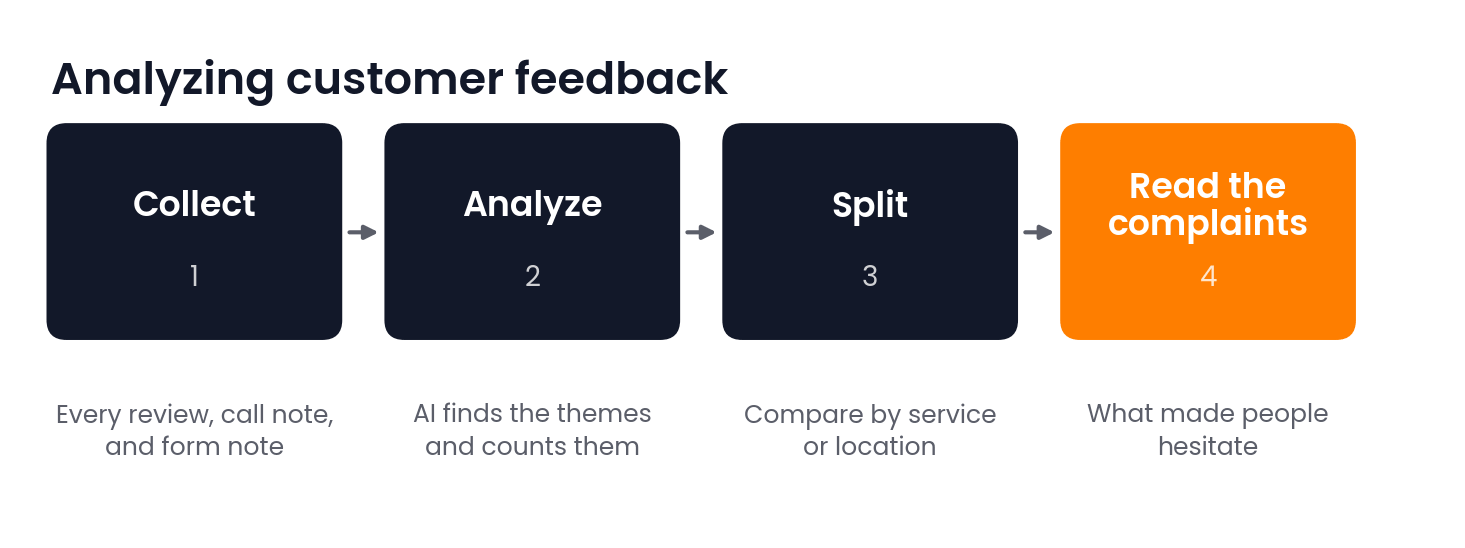
- Pull everything. Every review, not just the handful you remember. Add call notes and form notes if you have them.
- Ask AI for the themes and the counts. Give it the whole export. Ask what people praise, how often each theme comes up, and a few exact quotes per theme that you can trace back. AI does the counting. Spot-check a few counts before you trust them, and check every quote you plan to publish against the original. Once you have a theme list you like, hand the same list back every quarter so you can see what moves.
- Split it up. The themes at the top are what people value enough to write down, whether or not they’re the ones you’d have picked. Split them by service or location before you compare, since a busy parts counter will out-review a slow sales lot.
- Read the complaints. Run the low-star reviews, yours and your competitors’, on their own. Ask what went wrong and what made people hesitate before they hired anyone. Your pages should answer that.
A prompt this simple gets you most of the way:
“Here are 400 reviews. Group them into themes and give me a count for each, with three exact quotes per theme, including the reviewer’s name and date. Then list every complaint or hesitation, with counts.”
What comes back should look something like this, here from the plumbing company’s reviews:
| Theme | Reviews | In their words | Where it goes |
| The tech was professional | 125 | “professional,” “courteous” | Service page intro, Business Profile description |
| The tech explained the problem | 89 | “explained everything,” “walked me through” | Service page, “what to expect” section |
| A crew, not one guy | 82 | two or more techs named | About page, team photos |
| Speed | 66 | “same day,” “finished in one day” | Emergency pages, ads |
If the complaints keep pointing at something you actually do wrong, fix that before you write about it.
The analysis is the relatively simple part. The judgment is deciding which theme leads which page, how often to say it, and whether the change brought in more calls.
Where to use customer feedback
Customer feedback belongs everywhere someone decides whether to call, starting with the pages that never show a testimonial.
Homepage. Say what you do and where, plainly and up top. Then let your top theme decide what comes next. If customers keep praising techs who explain things, the line under your headline should say so, ideally in their words.
Service and location pages. Lead with the theme customers praise most for that service. Then answer the complaint or hesitation that comes up most for it. A water heater page might open on same-day replacement if that’s what customers praise, then answer the question every caller asks: what it costs to come out. Put a review or two about that service near the call button, from that town if you have them. Here are more ways to make location pages convert.
FAQs. Use the questions from your calls and forms, in the words people used. Answer each one in the first sentence.
Google Business Profile. Consider rewording your description around your top two themes. Choose services and photos that show them. If customers rave about the crew, show the crew.
Ads and keywords. Write headlines in customer language, not industry language. The way people describe a problem is often the way they search for it. We wrote a whole post on using reviews for local keyword research.
The phone. Give your front desk the top three themes and the most common hesitation. They’ll hear both on the next call.
Just don’t overdo it. We’ve caught our own drafts repeating specific reassurances a few too many times. Like keyword-stuffing, you can sentiment-stuff and end up counteracting your intended goal to win over your customers.
What happened when a dental practice tried it
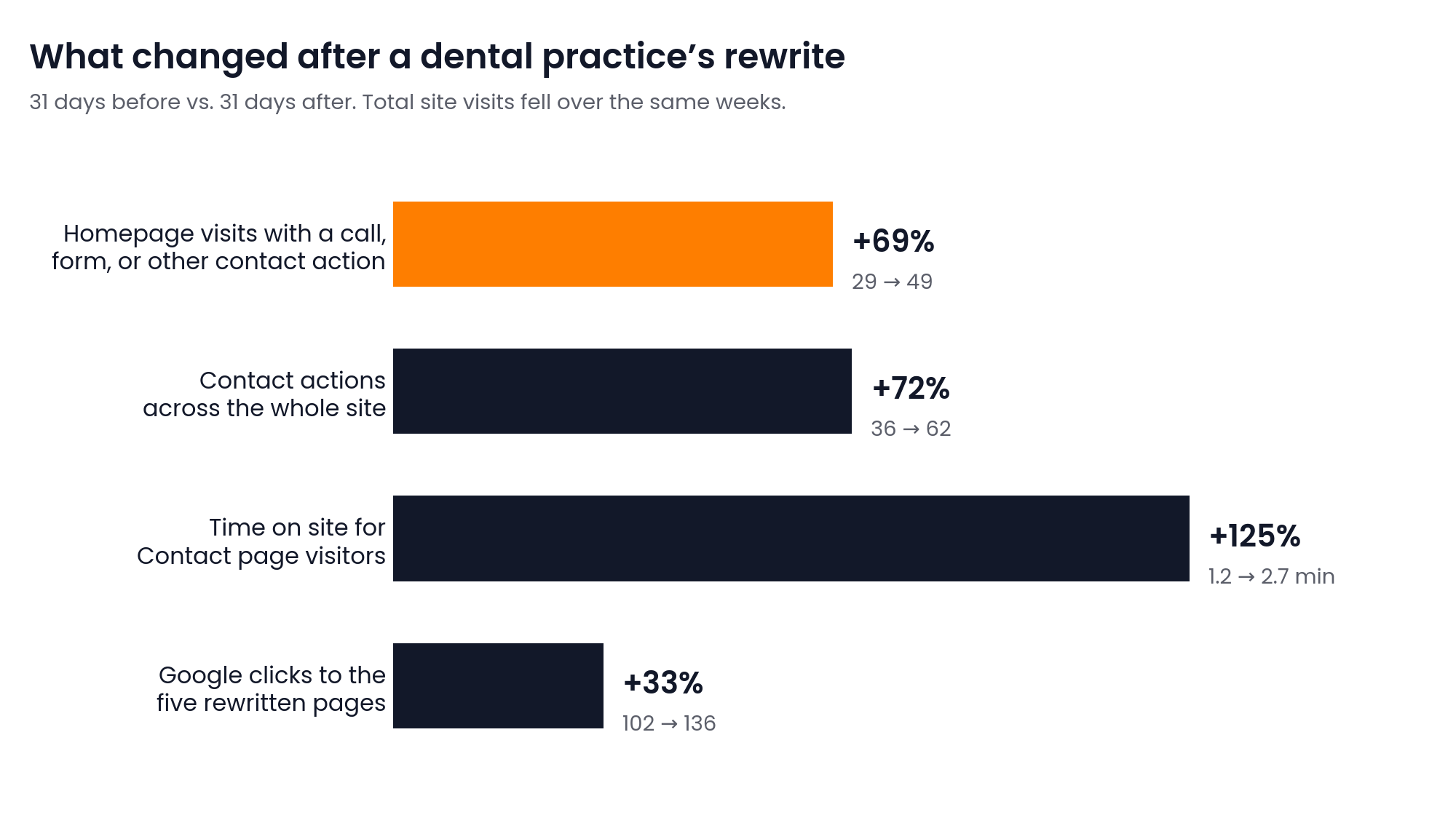
A dental practice we work with rewrote five pages around what its patients praise. The new headlines and opening copy lean on comfort and plain explanations. Short new sections speak to patients who show up nervous or years overdue. Then we compared the 31 days before the change with the 31 days after.
More people reached out after the rewrite, even as the rest of the site cooled off.
- Visits that reached the rewritten homepage and included a call, form, or other contact action: 29 to 49, up 69%
- Contact actions across the whole site: 36 to 62, even though total visits fell
- Time on site for people who visited the Contact page: 1.2 minutes to 2.7
- Google clicks to the five rewritten pages: 102 to 136, up a third
Over the same weeks, the site’s other pages slipped 6% in Google clicks, and its blog lost about a quarter.
Let your customers write your next page
The reasons people call you are already written down. Collect what customers said, let AI count it, read the complaints, and put the top themes where people decide. Then measure it.
Reading customer feedback is the first thing I do on any content project. It’s the fastest way I know to find what makes a business worth calling.
And we grade the work on booked jobs, not rankings. At Guardian Plumbers, organic search has booked about $1.08 million across 1,392 completed jobs. Their city pages are built around the services and questions people in each town actually have. For an HVAC company, one change to its Business Profile meant fewer lead calls, but completed revenue from those calls went from $8,763 to $61,020.
Wanna know what your reviews are saying that your website isn’t? Schedule a discovery call with RicketyRoo. If we think we can help, we’ll say so. If we don’t, we’ll tell you that, too.
Common questions about customer feedback analysis
How do you use customer feedback to improve local SEO?
Customer feedback improves local SEO by matching your pages to how people actually search. The phrases customers use to describe a problem are often the phrases they type into Google. Pages written that way give searchers a reason to pick your result.
How do you find patterns in customer calls?
Finding patterns in customer calls starts with transcripts from your call tracking. Ask AI to sort each call by the problem, the first question asked, and any objection, then count them. The questions that come up most belong on your pages.
Can you use AI to analyze customer reviews?
AI is the practical way to analyze customer reviews at any real volume. Give it the full export and ask for themes with counts and exact quotes. Check the counts, and every quote you publish, against the original. Reviews are public. Call transcripts and form notes aren’t, so strip names, phone numbers, and addresses before you paste those into an AI tool.
How many reviews do you need before the patterns mean anything?
Review patterns start to mean something once the same theme keeps coming back across dozens of reviews. The plumbing company above had 293 from about two months. A theme that shows up once or twice is an anecdote. With only a couple dozen reviews, add form notes and call notes to the pile, and start asking for more reviews.
