


Emergency plumbing searches are not normal SEO traffic.
Folks searching for an emergency plumber near me aren’t just casually browsing. They are not leisurely comparing 14 tabs over coffee. They may have water on the floor, sewage backing up, a busted water heater, or a pipe making sounds pipes should not make.
They need help.
Fast.
So if you want more booked jobs from emergency plumbing searches, your website has to credibly serve up answers to the following questions almost instantly:
- Do you handle this problem? Burst pipes, clogged drains, sewer backups, no hot water, sump pump failure, overflowing toilets, the whole lovely disaster menu.
- Do you serve my area? City, neighborhood, suburb, county, service radius. Make it clear.
- Can you help now? 24/7, same-day, after-hours, weekends, or “call for fastest availability.”
- Can I trust you in my house? Reviews, licensing, insurance, real photos, years in business, and proof that you have solved this kind of mess before.
- Can I call without thinking too hard? Click-to-call. Phone number up top. Sticky mobile CTA. Short form as a backup. No hunting necessary.
Here’s what it comes down to: Rankings get you seen. Trust gets you called. A clean call path gets the job booked.
Emergency Plumbing Searches Are Happening Right Now in Your Area
Emergency plumber near me is about as low in the funnel as you can get. Those searches are happening right now—near you.
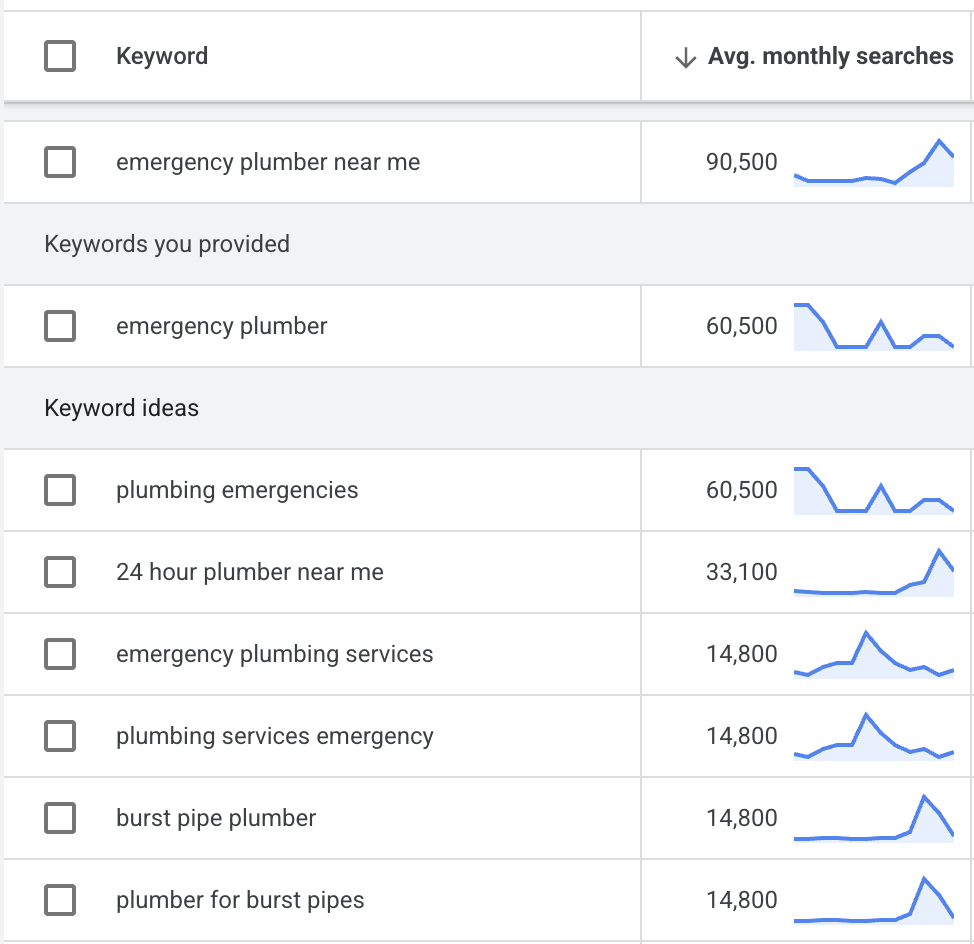
If your site isn’t set up to attract these searches, you’re sorely missing out on a steady source of leads. Local SEO is crucial for plumbers. The map pack, your Google Business Profile (GBP), your reviews, your service pages, your location pages, and your mobile experience all work together to land real leads.
Or they don’t.
And when they don’t, the call goes to the plumber with clearer hours, stronger reviews, and a call button that actually works. Essentially, the call goes to the competitor with better SEO.
Start With the Emergency Jobs You Actually Want
Before you build pages or chase keywords, get clear on the jobs you want more of. Not all emergency plumbing calls are equal. You may want more:
- Emergency drain cleaning
- Sewer backup jobs
- Burst pipe repairs
- Water heater emergencies
- Sump pump failures
- Frozen pipe calls
- Main line clogs
- Leak detection calls
- Gas line emergencies
Some jobs are more profitable. Some lead to better long-term customers. Some fit your team and service area better than others. Some are a pain in the ass operationally, and you may not want to build your whole SEO strategy around them.
Good local keyword research starts with “what calls do we actually want?” Then, you look at the search demand. Check Google Keyword Planner. Check Search Console. Look at competitors. Search the SERPs yourself from the right location. See what Google is actually showing.
Build the Right Pages, Not Just More Pages
Most plumbing companies that offer true emergency service should have a strong emergency plumbing page.
That page should explain:
- What emergency issues do you handle
- When you are available
- Where you work
- What the customer should do now
- When should they call
- Why can they trust you
- How to contact you fast
But that doesn’t necessarily mean you need a separate “Emergency Plumber in [City]” page for every city, suburb, hamlet, cul-de-sac, and suspiciously named township in your service area. Sometimes you need dedicated pages. Sometimes you don’t.
If you already have strong service area pages, a clear emergency plumbing section on each page may get you found. In a more competitive market, you may need a dedicated emergency page, stronger city pages, or both.
It depends. (No, for real; it does 🙃)
The real answer comes from the SERPs. Look at what ranks. Are the top results homepages? Emergency service pages? Location pages? Directories? Google Business Profiles? Spammy nonsense somehow held together with duct tape and hope?
Build based on what the market calls for. More pages is not a strategy. Sometimes, more pages just dilute your ranking potential.
Speak to the Problem Your Potential Customers Have Right Now
Emergency plumbing pages should speak to symptoms, not just services.
“Emergency plumbing repair” is fine. But it is not enough.
Say the thing the customer is dealing with:
- Water coming through the ceiling?
- Toilet overflowing?
- Sewer smell in the house?
- No hot water?
- Pipe burst overnight?
- Basement drain backing up?
- Sump pump stopped during a storm?
That kind of copy helps visitors feel they are in the right place. It also helps you avoid writing generic service-page sludge. You know the stuff:
“Here at ABC Plumbing Solutions, we provide comprehensive plumbing services tailored to meet your needs.”
Cool. But the kitchen is flooding.
A strong emergency page should tell people what to do next. It may also tell them what not to do.
For example:
- Do not keep using fixtures if sewage is backing up.
- Shut off the water if you can do so safely.
- Move valuables away from standing water.
- Call now if water is spreading or you smell gas.
This is useful. It builds trust. It shows you know the situation.
A person with sewage backing up into the basement does not need your brand manifesto. They need to know you have seen this movie before and can send help.
Reviews Are Emergency Conversion Copy
Reviews are not just trust signals. They are legit conversion copy. And the beauty is that your prospective customers know the reviews are from real customers about real moments where something went wrong, and your team fixed it.
For emergency plumbing, the best reviews often say things like:
- “They showed up fast.”
- “They answered the phone.”
- “They came out on a Sunday.”
- “They explained everything.”
- “They fixed it the same day.”
- “They cleaned up after the job.”
- “They did not pressure us.”
- “The price was fair.”
- “The technician was calm and professional.”
That language matters because it speaks to what future customers care about.
A person with a sewer backup wants to know you will show up, solve the issue, explain the work, and not make the day worse.
Use that language on your pages. Not in a fake way. Not in a “we deeply value our customers and provide world-class excellence” way. In a real way.
If customers praise your fast response, say you offer fast emergency response. If they praise your clear explanations, say your techs explain the issue before work begins. If they praise clean work, mention that your team treats homes with care.
“Showed up fast and explained everything” beats “committed to excellence” every day of the week and twice during a sewer backup. Our guide to using reviews for local keyword research goes deeper into how customer language can shape stronger content.
Make the Call Path Supremely Easy on Mobile
Emergency plumbing searches happen on phones, so the mobile experience has to be frictionless.
Ideally, that means something like this:
- Phone number near the top
- Click-to-call button
- Sticky mobile CTA
- Short form for people who cannot call
- Clear “call now” copy
- Fast load time
- Reviews or trust proof high on the page
- Service area visible early
- No giant sliders
- No tiny phone number hiding in the footer like it owes somebody money
This is where SEO and conversion rate optimization meet. You can rank. You can get the click. You can still lose the job because the page makes the next step annoying.
If someone has to pinch, zoom, hunt, scroll, and squint to call you, then you’re just bleeding dollars.
Page speed still matters here. Not because it is a fun technical score to obsess over, but because a stressed mobile visitor will not wait around while your hero image of a smiling technician slowly descends from the heavens.
Your Website and Google Business Profile Have to Work Together
A lot of plumbing companies think Google Maps rankings are all about the Google Business Profile.
The profile matters. A lot.
But your website still helps Google understand what you do, where you do it, and which searches you should show up for. Whitespark’s Local Search Ranking Factors report treats on-page signals as a meaningful part of the local pack and Google Maps ranking conversation, not just as a traditional organic SEO concern. When your website clearly showcases your emergency work, your Google Business Profile is more likely to appear when potential customers near you search for emergency plumbing help.
Still, for emergency searches, it’s worth calling out that your Google Business Profile may still win the call before your site gets a shot.
A customer searches. They see the map pack. They check ratings, hours, proximity, and reviews. They hit call right there from the Business Profile. Ongoing optimization for your GBP can help you be the plumber that shows up and gets the call.
A Simple Emergency Plumbing SEO Plan
If you nail the basics below, you’re probably going to win more emergency plumbing jobs from search.
Not because you found some magical SEO loophole. Because you made it easy for the right person to find you, trust you, and call you when the problem is very much not theoretical.
- Pick the emergency services worth booking. Focus on the jobs that matter most to the business.
- Check the SERPs in your market. See what Google rewards for those searches.
- Decide what pages you need. Dedicated emergency page? Stronger service area sections? Better service pages? Choose based on intent, competition, and overlap.
- Tighten the on-page signals. Make services, locations, emergency availability, and trust proof clear.
- Improve the Google Business Profile. Categories, services, hours, reviews, photos, Q&A, and call path.
- Use reviews to strengthen the copy. Let real customer concerns shape the page.
- Fix the mobile experience. Make calling easy. Make trust obvious. Make the page fast.
You Don’t Need More Plumbing Traffic. You Need More Plumbing Jobs.
Emergency plumber SEO works when the whole path holds together.
Your website has to be clear. Your Google Business Profile has to be strong. Your reviews have to support the decision. Your pages have to speak to real problems. Your mobile experience has to get out of the way. Your reporting has to connect search visibility to actual work on the schedule.
That is the work RicketyRoo cares about: turning search visibility into real plumbing jobs.
We help home service businesses figure out what is getting in the way, whether that’s weak local visibility, thin pages, messy Google Business Profiles, bad conversion paths, unclear tracking, or some ugly little combo platter.
If emergency searches appear in your reports but not on your calendar, get in touch with RicketyRoo. We’ll talk through what makes sense, what doesn’t, and where the real leak is.
